
Making it Happen in the Sunshine State: Traffic and Bicycle Safety Education Program
By George Martin and Walter Nygard
Palm Beach County Sheriff’s Office
Traffic and Bicycle Safety Education Program
West Palm Beach (FL )
The Florida Traffic and Bicycle Safety Education Program has been in operation in Palm Beach County for two years. It was introduced to address the high incidence of pedestrian and bicycle injuries and deaths due to traffic, the single greatest risk for children. Children normally receive bicycles as toys and are taught only how to operate them. It is rare for children to learn about the rules of the road and the hazards of the interaction between bicycles and other traffic on the roadways. They are rarely introduced to the principles of safe cycling, and the result can be tragic. Most collisions occur due to failure to stop or yield at intersections, riding against traffic, and entering a street without scanning for traffic; these skills are easily developed through repetition.
Compounding the lack of education is the tendency of children to exhibit behavior similar to that of adults on the roads. The lack of consideration for others and disregard for rules and risk that characterizes many motorists is also demonstrated by kids on bikes. It is the goal of this program that intervention – coupled with frequent and continuing exposure to key safety principles – will result in significantly improved sense of awareness and reduced traffic casualties. At this time, the program is geared towards elementary school ages; however, there are plans to introduce programs into the middle schools and beyond, in the hope of having a favorable impact on children as “grow up into” motorists. The goal, too, is to develop well-informed adults who will engage in bicycling as a sport or as transportation and derive the many benefits associated with the activity.
The Florida Traffic and Bicycle Safety Education Program
The program is conducted by the Palm Beach County Sheriff’s Office (PBSO) and funded by a grant from the Florida Department of Transportation, under The National Highway Traffic Safety Administration (NHTSA). The three-year grant covers most of the new equipment costs, while personnel costs are covered on a declining basis. The remainder is funded by the Sheriff’s Office. The grant provides funding for bicycle helmets, purchased at a discount through the Florida State SAFEKIDS Coalition Coordinator, for economically disadvantaged children.
The program is coordinated by Corporal Bob Ricciardi, head of the PBSO Bicycle Unit, and implemented by two Bicycle Safety Educators, George Martin and Walter Nygard. The program is actively supported by the Sheriff and the County School Superintendent, both of whom are avid bicyclists. The educational materials and training are provided by the University of Florida Department of Urban and Regional Planning. The training team is equipped with four trailers, two trucks, 125 bicycles, and related equipment. The goal for the current year is to deliver the program to 30 schools, reaching about 20,000 children. Eventually, the program will be expanded to encompass all 90 public schools in the district and nearly that number of private schools every year.
The program consists of two separate but related activities: school programs and bicycle safety rodeos.
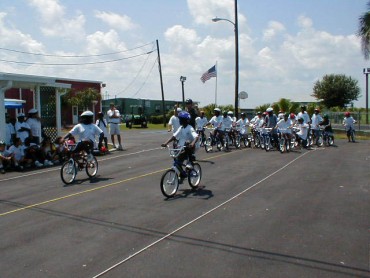
The school program is conducted in elementary schools. The program’s state certified Bicycle Safety Educators train the teachers – usually physical education teachers – to conduct the program. The teachers then incorporate the program into the schools’ normal class periods and conduct the training on school grounds. The program requires about five classes per student for completion and concentrates on traffic awareness, helmet usage and state laws. A trailer outfitted with 35 bicycles, loaner helmets, signs, cones and the equipment necessary to set up a mock roadway intersection is delivered to the school for the training sessions. Videos and other aids are provided for indoor instruction. Kindergarten to second grade children are trained in pedestrian and bus safety, while third to fifth graders receive bicycle safety instruction.
The Bicycle Safety Educators assist the teachers as needed, particularly the first time the program is offered. Handling 30 kids in class is tough enough – imagine them all on bicycles! The teachers like the courses. The kids love it, so disciplining them is pretty easy. A time out in “jail” usually resolves any problems since they don’t want to miss the “fun.”
And, of course, the Bicycle Safety Educators like it because they get to wear shorts and sneakers to work and play with kids on bikes all day.
The bicycle safety rodeo program includes similar principles and activities, but on a much more limited scale. The rodeos are normally conducted on weekends in area parks or other locations, often in conjunction with other activities, such as health fairs. Schoolteachers, sheriff’s deputies, police officers, and other officials are trained and certified to conduct rodeos. Once trained, they have access to the equipment to conduct rodeos on their own to further their community safety initiatives.
The Bicycle Safety Educators then assist them as needed. Bicycle safety events are enjoyable and, with the proper planning and preparation, easy to present. Difficulties can arise when there are large numbers of participants and limited assistance, reducing the contact time and probability of a meaningful, professional presentation. Rodeos are most successful when conducted for controlled groups of children, such as Scouts and other youth groups. These events can be held over a four to six hour period and should allow time to show videos, hold discussions, do active course work and include a picnic lunch break. Ideally, parents will be present. Demonstrating concern for the safety of the children in the neighborhood is a great way to enhance the image of law enforcement in a positive, proactive manner, and the rodeos provide another way to “get the word out” about bicycle safety.
All of our efforts are coordinated in a “whole community” approach. The program educates the children, informs the parents, and involves law enforcement and school officials. When we have completed training in the schools in a community, we ask the schools to require children under 16 (Florida law) to wear helmets when riding bikes on school grounds and to and from school, and to encourage adults to do the same. We ask law enforcement agencies in the community to enforce all applicable bicycle and pedestrian laws. Their support is essential because the program staff can only be visible to the children for a few weeks per year. One of the goals of the program is to create year-round safety awareness by involving more people and activities. We believe that continued exposure to the safety principles in many different formats throughout the year will achieve the desired results.
Other elements of an effective community traffic safety program are:
- Safe route-to-school maps and patrols;
- PTA family safety nights;
- Secure bicycle parking areas;
- Bicycle patrols for neighborhood safety;
- Pedestrian crossing and school zone enforcement efforts.
Typical School Class Schedule
The individual lesson plans of the course are detailed in a comprehensive manual that is provided to the teachers when they complete the certification training. The pedestrian and bus safety course for the K-2nd grade age group consists of instructional videos and exercises that teach such principles as identification of traffic hazards, visual barriers, roadway and driveway approaches and correct procedures when on or near a school bus. This course is unstructured, and each of the exercises is brief and designed to be practiced as a part of the normal daily activities of the class.
The bicycle safety course begins with a safety survey, which is conducted as the children arrive or leave school. Children on bicycles with and without properly worn helmets are counted. After the completion of the course, another survey is completed. We also count those on inline skates, scooters and skateboards and report the results to the school. A pre-course quiz tests the students’ understanding of bicycle safety, and is given again at the end of the course.
The course itself is comprised of a series of progressively more complex tasks that build on each other. The first part of a course, normally conducted indoors, includes bike safety videos, exercises and helmet familiarization. The groundwork is laid for later practical application on the bicycles. Proper fitting of the helmet and the reasons for helmet use are covered. Loaner helmets are provided for use during the classes and the children learn to identify the proper size and make proper adjustments. Reasons for the laws are discussed. Every effort is made to relate these principles in terms that the kids can understand. For example, “if you are riding your bicycles with all your buddies in a line going as fast as you can, and the first person in line slams on the brakes, what will happen?” They know. Now ask them how to prevent an accident. They will figure out that if you communicate your intentions to others, traffic accidents can be minimized. Hence the laws mandating the use of turn indicators, brake lights and hand signals on the roads. Placing an egg in a helmet with padding and dropping it demonstrates the effectiveness of proper helmet use.
After the indoor activities, the much anticipated bicycle drills begin. A safety and bike fit check is conducted to familiarize the kids with the bikes. Brakes, tires, and general condition of the bike are explained. All the “do’s” (follow the rules, use consideration for others) and “don’ts” (wheelies, ghost riding, racing, crashing, rude behavior) are discussed. The first series of activities is designed to see if they can follow instructions, ensure that they understand that the rules will be enforced, and to see if they can ride the bikes. Each child is issued a bike and assigned to one of four straight lanes. They ride one per lane at a time to the stop sign at the end of the lane, come to a full stop, look carefully and if clear, return to their original position. Sounds easy, doesn’t it? Just like all kids, they will see what they can get away with and push as far as they can. The “jail” usually fills up quickly until they all figure out that the educators are serious.
The layout for the second outside bike class is the same: four lanes with stop signs. After receiving instructions on how to give proper hand signals for stopping and slowing, the children ride to the designated mark, give the signals, then stop as before. Vocal signals (“stopping!”) should accompany the hand signals and be used in place of them by any child who has trouble riding with one hand. Yielding to others while stopped is emphasized, as their initial impulse is to stop (maybe...) for the shortest time possible and to jump in front of others. Once the stopping signal is mastered, left and right turn signals are incorporated. Progress in each class depends on many factors; and although this section sometimes requires another class period, perfection is not as essential as having them understand the importance of communication and to initiate the signal in some form. It’s the thought that counts.
The remaining one or two classes focus on how to negotiate a tee or four-way intersection. This gets interesting. Imagine thirty kids on bikes all going different directions and signaling, yielding, stopping, and crossing at one time! Again, enforcement is the key to control, and it is important to keep in mind that the kids need enough freedom to have fun and think for themselves. It is usually necessary to stop everyone after a few minutes and remind them that this is a safety course and they are supposed to be demonstrating the principles they have learned. They need to be reminded that the fun and excitement of all the activity comes with a risk; which is the same thing many drivers seem to forget on the roads.
At both school courses and weekend safety rodeos, some skills training is incorporated to supplement the safety lessons. The skills consist of low-speed coordination and balance drills similar to IPMBA cone-course training – not racing or BMX events. The skills drills add variety and provide the opportunity to develop competitive events, thereby contributing to the goal of a year-round safety awareness campaign. One possibility is to conduct a countywide competition for bike safety and skills. Winners of local contests conducted throughout the year by the county schools would have the chance to compete in a final highly publicized annual event.
We have found the Traffic and Bicycle Safety Education Program to be an excellent way to present safety and law enforcement principles in an enjoyable, positive way, and in an environment that the children understand. They are responsive to the lessons, and their behavior can change over the course of a single class. During the training exercises, we can stop the action and discuss it with the whole group, then start up again. The risk of serious consequences is minimal. We can talk about risk and consequences and individual responsibility. Our firm belief is that these impressions will remain and, if reinforced by repetition, be firmly in place when these children use their bikes at home and eventually take to the roads on bicycles and in automobiles.
(c) 2002 IPMBA. This article appeared in the Spring 2002 issue of IPMBA News.