
Gears & Gadgets: Where the Rubber Meets the Road
By David Cohen, Maryland National Capital Park Police Reserve Unit
I don’t think there is anyone involved with cycling who has not heard the saying, “Keep the rubber side down.” It is pretty sound advice. However, what kind of rubber is keeping you and your bike attached to the road is almost as important as keeping the rubber side down.
Regardless of the size of the wheel, bicycle tires all have several factors in common.
Width: Width is usually the most commonly considered factor in choosing a tire. Tire widths can vary from 23mm (less than an inch) for road bikes to 4 inches (10.16 cm) or more on the “fat” bikes, and some e-Bikes. Generally, for public safety cycling (with the exception of e-Bikes) a width of 2.0 to 2.4 inches (5.08-6.02 cm) is usually considered the standard.
Conventional wisdom dictates that a narrow tire will run faster due to its narrower contact patch, and that it requires higher psis. Conversely, a wider tire will have a larger contact patch and can run at lower psis for greater traction, but will run more slowly due to increased friction. One must be careful not to get a tire that is too wide and won’t fit in the rear triangle or the front fork. There are other qualities, however, that could potentially enable a wider tire to run faster than a skinnier one. Read on!
Compound: Does the tire have a hard compound (faster, less traction) or a softer compound (slower, more traction)? Harder compounds will also have longer tread life. Some tires with softer compounds are good for only about one year of riding before they are done. There may also be increased flat resistance with a hard compound.
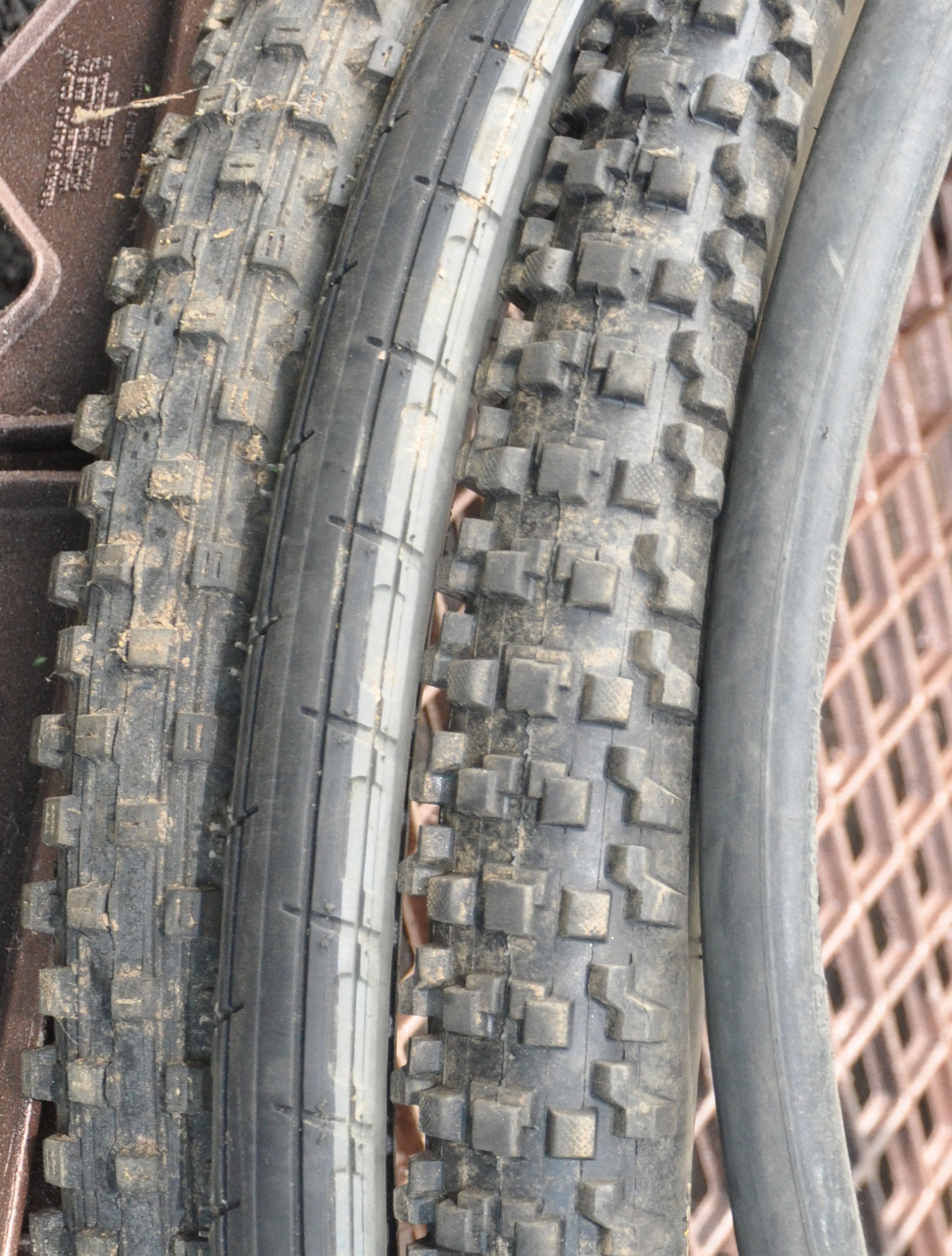
Tread: The closer you get to a slick surface, the faster the tire will be. That speed, however, is at the expense of traction, particularly when conditions are less than ideal, such as wet or off-road surfaces. Mountain bike tires are available with a variety of knobby styles designed for different types of riding conditions. Knobbies, however, tend to provide inconsistent grip on paved surfaces.
Shoulder: This is the profile of the tire. Some tires have a rounded shoulder, while some are more square. The squarer the shoulder, the greater the size of the contact patch. You could have two sets of 2.2-inch (5.59 cm) tires, but the ones with the squarer shoulders are going to put more of the width on the ground.
Weight: Almost all manufacturers will tell you how many grams their tires weigh. There are about 450 grams in a pound. So, the difference in a 650-gram tire versus an 875-gram tire is about a half-pound. And, because the tire is rotating weight, any increase or decrease will be felt out of proportion to the actual weight.
Budget: Let’s face it. It is pretty hard to justify top-of-the-line tires that may cost two to three times more than some other lines of tires. That said, in my own personal experience, inexpensive, “no- name” brand tires usually end up costing more money in the long run. A quality tire is well worth the extra expense. Be a savvy shopper: discounts can often be found on “close outs” on discontinued lines of tires from reputable manufacturers.
I run a mix of tires on my personal fleet of 26-inch wheeled bikes. Both the tandem and a recent build that I did for the volunteer/ranger program are equipped with Bontrager 26 x 2.0s The Trek 6500 that I used as a duty bike for more than 10 years has Maxxis 26 x 2.1 tubeless tires. The old Klein Pulse Comp hardtail that I converted to a rain/commuter bike runs a set of 26 x 1.5s, and the 1996 Trek Police Bike (see “Forward from the Past” in the 2020 Product Guide issue of IPMBA News) has a set of 26 x 1.75s. My old-school Trek 8500 hardtail wore Panaracer Fire XCs 26 x 2.1s for many years. But the tread patterns and the compounds really define how the bike rides. Despite being the narrowest tires, the 1.5s on the Klein have the best wet weather characteristics due to their tread pattern. Likewise, the Maxxis 2.1s have the best off-road capabilities.
When my 29er mountain bike needed new tires, I went to my local bike shop. I was running a set of Maxxis 29 x 2.2 tires on the bike. They fixed me up with a set of Bontrager XR2 29 x 2.4 tires. While the clearance in the rear triangle was extremely tight, it was literally love at first ride. Despite being wider, these tires rode faster and had more grip.
I was so impressed by the improvement in wider tires that when it came time to replace the Panaracer Fire XC Pro 26 x 2.1s on my 26-inch mountain bike, I went for broke and bought a pair of Kenda Nevegal 26 x 2.35 tires. I fully expected the same result, but the results were completely different. The Nevegals were very grippy. It was almost impossible for them to snap loose and I could roll over just about anything. All that grip came with a huge price: the increased weight and increased friction turned the bike into an almost literal drag when the terrain was pointed uphill, and if you tried to ride the bike on pavement, it was like riding in wet cement.
What went wrong? Upon closer examination, I realized the weight penalty was huge. While comparing a 29-inch tire to 26-inch one isn’t really apples-to-apples, when I did compare the two brands in the 29-inch size, there was more than a 300-gram difference per tire (630 vs. 940) between the Kenda and the Bontrager. That is an increase of nearly 1.5 pounds with the front and rear tires combined, and a much greater apparent difference because of rotating weight.
The Kenda Nevegal also had a considerably softer compound than the Bontrager XC2. The XC2s gave me a lot of grip, but the Nevegals were like a magnet. Increasing the tire pressure over my normal 30 rear/25 front to 45 rear/40 front improved the rolling resistance while still maintaining a fairly decent amount of grip. However, no increase in tire pressure could negate the significant weight penalty.
What tire is right for you? IPMBA generally recommends tires no narrower than 2.0 inches (5.08 cm) for public safety riding. The rest of the decisions come down to the environment you’re riding in and your budget. The objective is to find tires that are durable enough for day-to-day public safety use, provide enough traction to operate safely in the riding environment, and accomplish those goals with the least weight penalty. If I was setting up a public safety bike, I’d run a semi-slick or a slick tire with a good tread pattern in the 2.0 – 2.2 range with a stiffer compound, both for longer tread life and for flat resistance. Your setup needs may vary.
Regardless of the tire choice, one thing is universal: tires work better when they are in contact with the ground. Keep that rubber side down!
Gears & Gadgets is a blog written by David Cohen #1116. It features various repair tips and tricks that David has picked up in nearly 25 years of cycling, including 12 years of public safety cycling. Gears & Gadgets will also periodically review some of the latest “gadget” items of potential interest to public safety cyclists. The advice and opinions in this column are solely the author’s and should not be interpreted as IPMBA mandates or recommendations unless explicitly stated.
About the author: David Cohen is a 12-year volunteer with the Maryland-National Capital Park Police. When he isn’t riding or tinkering with bicycles, David can be found tinkering with vintage cars or World War II airplanes. An avid historian, David enjoys researching and writing as well. He can be reached at onyxsax@aol.com.
(c) 2020 IPMBA.