
Gears & Gadgets: The Humble Cyclo-Computer
By David Cohen
Maryland National Capital Park Police Reserve Unit
The amount of data that is available to cyclists today through various devices is absolutely astonishing: GPS mapping, heart rate monitoring, pedal cadence, power meters…the list goes on and on. Some of these devices are stand-alone items, while others integrate with your smartphone, which can now be mounted to the bicycle as well. There is so much information available that we feel we have to monitor that many of us suffer from “paralysis by analysis”. We’re trying to process too much information. As cyclists, particularly when operating in the public safety role, we need to ask ourselves, “What information do we really need?”
While I’m a huge fan of the heart rate monitor (See Gears and Gadgets 15: GPS Watches), when it comes to the on-bike information, I just want the basics: speed, distance and time. You don’t need a fancy bike mounted GPS for that, nor do you need a smartphone. When it comes to the pure basics of cycling, it’s hard to come up with more bang for the buck than the humble cyclo-computer.
Cateye has long been the “go to” brand for cyclo-computers, having produced one of the first cyclo-computers nearly 40 years ago. Like any good cycling company, they offer a range of cyclo-computers from basic to very advanced. The one I have come across most often in the public safety role is the Cateye Velo. My department-issued bicycle has a Cateye Velo 5 that is well over 10 years old and still works flawlessly. The Velo provides the basic information a cyclist needs, it’s fairly inexpensive, and is relatively easy to install and maintain. The biggest drawback of the earlier versions was that they required a wire connection from the stem (or handlebar) mount to the sensor on the front fork. A neat installation usually required wrapping the wire around the fork or handlebar, or in some cases the cable housings, though I would not recommend this. The wire cluttered up the bicycle and made maintenance more difficult. Happily, Cateye now offers the Velo in a wireless package. You get all the benefits of the Cateye Velo without the pesky wire.
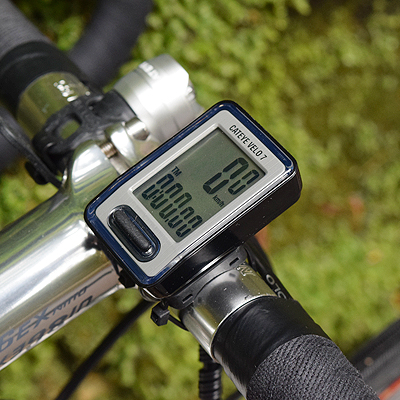
I purchased a pair of Cateye Velo 7 Wireless units for my personal use. I installed one on my recently purchased gravel bike. I installed the other one on my 26er. Installation was pretty straightforward. The only trick is making sure the sensor and the wheel magnet are no more than a half-inch (1.27 cm) apart. That proved to be a bit tricky on the gravel bike as the wide fork (to accommodate larger tires) made it difficult to get the sensor close to the wheel. It was a bit easier on the 26er. Not having the pesky wire to deal with was a huge plus, and the installation looks very clean.
Programming the Cateye is pretty straightforward: set the wheel size, the units of measurement (standard versus metric), and the time. To preserve battery life, the Velo 7 has a “sleep” mode, which essentially shuts off the cyclo-computer until you hit the button. The display is very legible from the saddle and is easy to read in just about all conditions.
While riding, the Cateye gives you all the information you need. Its only failing is that accuracy is dependent on wheel size. For example, in the 700c setting on my gravel bike, the Cateye under-measures, meaning both speed and distance are greater than what you see, when compared to a bona fide GPS unit like a Garmin. On the other hand, in the 26-inch setting on my 26er mountain bike, the readings are much more accurate. The sensor occasionally becomes fickle – either not registering at all or registering a speed that is simply impossible. For example, on one ride, the Cateye registered my maximum speed at 59.7 miles (96 km) per hour, while my GPS unit registered a more modest 33.8 miles (54.4 km) per hour as the maximum speed. I tend to believe the GPS reading is more accurate, as I’ve never had a bicycle above 45 miles (72 km) per hour. The accuracy issues can be mildly annoying, but as they say, they are “close enough for government work”.
The Velo 7s strength lies in its simplicity. A public safety cyclist leads a fairly complex life between their operational SOPs as well as the demands of their other equipment. Why make things even more difficult for the rider, particularly those who are new to public safety cycling? When training new riders, they only must learn to press one button. That’s it. The rider doesn’t have to worry about picking up a cell signal or a GPS signal. This means the cyclo-computer will work in places where ordinary GPS or cell phone units may not, such as in tunnels or underground parking garages.
The biggest advantage the Velo 7 Wireless has over GPS units is its price: it generally lists for $44.95 for the wireless unit. If dealing with the wire doesn’t bother you, you can get a unit for around $29.95, but wireless is worth the extra cost. When you consider that the least expensive Garmin GPS unit is $199.99, you could equip five bicycles with the Cateye Velo 7 Wireless for the same price. To sweeten the deal, Cateye offers IPMBA members a one-time discount of 50% off. For departments whose bicycle units are on a shoestring budget, that is a very significant difference.
The on-bike GPS units and various cell phone applications available to cyclists are wonderful training tools when riding recreationally. They can even confer “bragging rights”. However, when a public safety cyclist is “on the clock”, how much information do we really need? I think that just having the basics is all that is truly necessary for an on-bike unit. When it comes to providing that kind of basic information in a budget-conscious package, it is very hard to beat the humble cyclo-computer.
Cateye Velo 7 Functions
- Current speed
- Maximum speed
- Average speed
- Trip distance
- Total distance
- Elapsed time
- Clock
Features
- Auto start / stop
- Pace arrow
- Simple tire size
- Programmable odometer
- Zip tie mount compatible with FlexTight™ universal bracket
Gears & Gadgets is a blog written by David Cohen #1116. It features various repair tips and tricks that David has picked up in more than 25 years of cycling, including 15 years of public safety cycling. Gears & Gadgets will also periodically review some of the latest “gadget” items of potential interest to public safety cyclists. The advice and opinions in this column are solely the author’s and should not be interpreted as IPMBA mandates or recommendations unless explicitly stated.
About the author: David Cohen is a 15-year volunteer with the Maryland-National Capital Park Police. When he isn’t riding or tinkering with bicycles, David can be found tinkering with vintage cars or his collection of 19th and early 20th century musical instruments. An avid historian, David enjoys researching and writing as well. He can be reached at onyxsax@aol.com.
(c) 2023 IPMBA.