
Gears & Gadgets: Gravel Bikes—The Future of Public Safety Cycling?
By David Cohen
Maryland National Capital Park Police Reserve Unit
There comes a time in every cyclist’s life where no matter how much they love riding a particular bike, it’s time to move on. For me, 2022 was that year. I purchased a 4-year old road bike secondhand back in 2008. Over the intervening years, I literally rode the wheels off it. I found, though, as I continued to get older (not to mention carrying some extra pounds on my own frame), the hills on the undulating terrain where I live were getting steeper with each passing year. The 39 front / 32 rear combination on the easiest gear on my road bike just wasn’t getting me to the top of the hills without risk of me blowing up.
I contemplated getting a larger rear gear or changing out the front chainring for something smaller, but in my experience, when you start making changes like that, the bike seldom ends up being the sum of its parts. It was time to say goodbye to my 18-year old road bike and replace it with something new. After chatting with my local bike store staff, deciding which attributes I wanted, such as disc brakes and, of course, lower gears, and considering the types of roads I ride on, going the gravel bike route seemed to make the most sense.
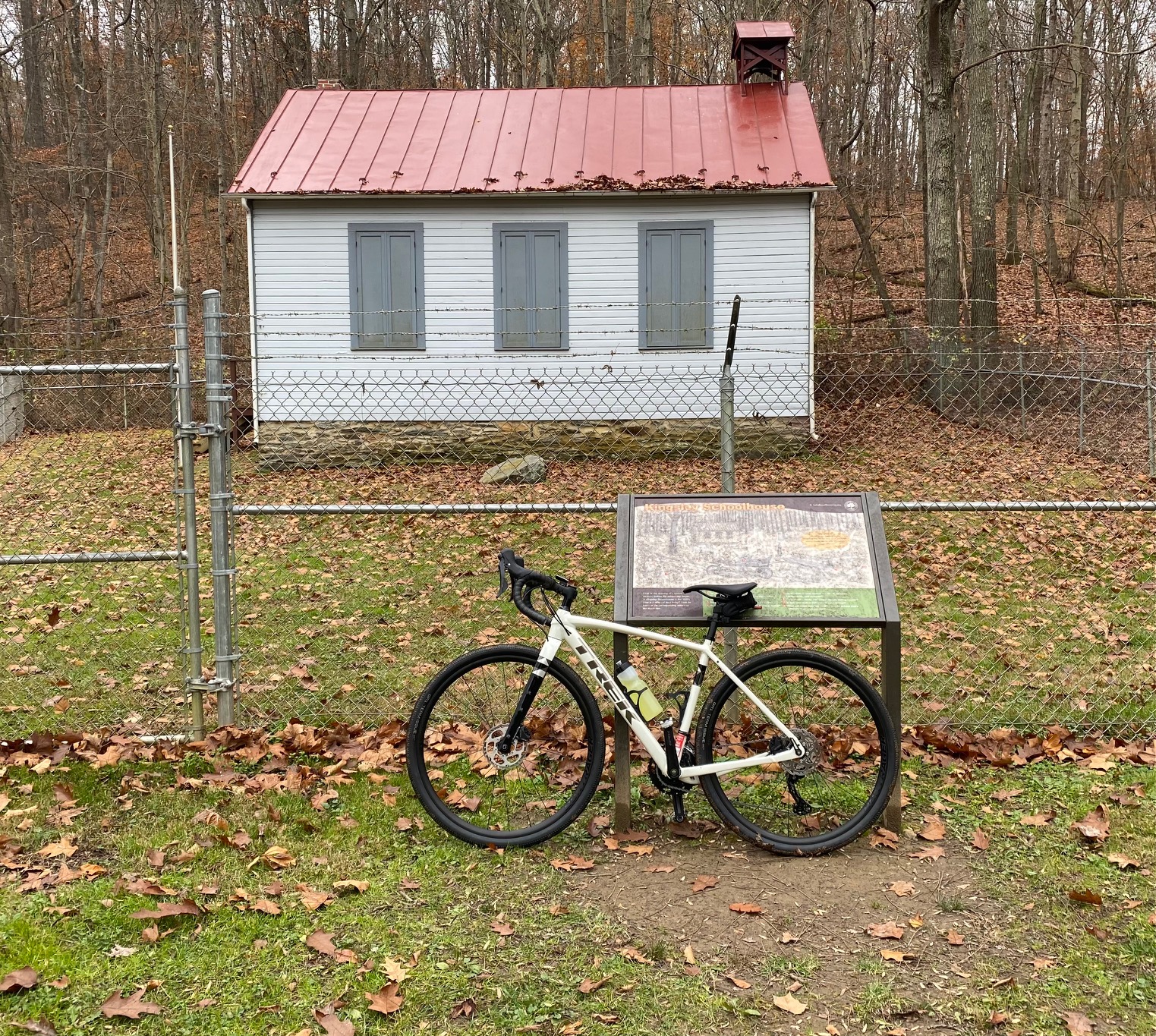
I purchased a Trek Checkpoint ALR5. The ALR5 is Trek’s top-of-the-line aluminum frame gravel bike. Once you get past the ALR5, you start getting into carbon fiber frames. I chose aluminum instead of comparative carbon fiber offerings for the additional ruggedness aluminum has over carbon fiber.
The Checkpoint comes equipped with Shimano’s new GRX group. The GRX is the gravel bike equivalent of the Shimano 105 group for road bike. A two-ring front chainring of 46/30 combined with an 11-speed, 11/34 rear cassette gives you a wide range of gearing that will handle just about any condition except bombing down a long, paved hill. Shimano’s hydraulic disc brakes engage smoothly and have tremendous stopping power. The bike comes stock with 700 x 40 tubeless tires, but it can accommodate a wide variety of tires, ranging from 28 to 45 mm. The bike tips the scales at around 21.5 pounds (9.75 kg) for the 56 cm frame.
What sets the Checkpoint apart from road bikes, mountain bikes, and even other gravel bikes are the number of attachment points for storage bags, panniers and racks. Mounts are located on the front fork, top of the top tube, underside of the top tube, down tube, seat tube, and seat stays. Theoretically, you could mount three or four water bottles on the bike. Trek also makes custom packs to take advantage of these mounts. The total all-up maximum capacity for the Checkpoint is 275 pounds (125 kg), which includes rider and equipment. That’s an impressive load.
The 46/30 chainring takes some getting used to compared to the standard 52/39 on a road bike, or the 22/33/44 triple on many mountain bikes. With the latter two, the “double shift” – shifting the front and rear derailleurs simultaneously with a larger front/larger rear or smaller front/smaller rear combination – tends to yield a gear that is comparable to the gear you were in without a significant change in your pedal cadence. If you try a double shift on the gravel bike, you’ll either find yourself spinning out in a smaller front/smaller rear combination or suddenly having to use a lot more effort in a larger front/larger rear combination. What I found was you need to either go up or go down two or three gears when shifting the front chainrings to maintain a relatively steady cadence. It’s a bit annoying at first, but once you get used to it, it becomes second nature.
Out on the road, the Checkpoint is very stable. It is responsive and can be pushed into turns with confidence. Overall, it rides like a dream. You would not believe you are riding on a full aluminum-frame bike. Most of that cushiness is due to the 40mm tubeless tires, which have a maximum tire pressure of 50 psi. This is considerable softer than the 120+ psi you find on 23mm road bike tires. Of course, the trade-off with wider and softer tires is a significantly increased rolling resistance. You do not want to try to best your PR on Strava with this bike! On average, I’ve found that my average speed is about one mile (1.6 km) per hour slower than on my road bike. However, the reduction in speed is well worth the superior stability.
As good as the Checkpoint is on pavement, it really comes into its own when you take it off the road. The bike glides easily across gravel surfaces with almost the same level of comfort as if you were riding on pavement. It is probably not the best choice for singletrack trails, but it can handle them should the situation arise. My gravel times were almost neck-and-neck with my pavement times, and considerably faster than on the converted mountain bikes that I have ridden on gravel in the past. It was also faster than my road bike as I would have to ride much more gingerly over rough surfaces than I can with the Checkpoint.
My opinion is the gravel bike is not a passing fad. It is here to stay. It is simply way too versatile of a package to be ignored. It may not be as quick as a road bike, or beefy enough to take on serious off-road riding, but it can handle a wider variety of conditions more efficiently than either type. I also believe that gravel bikes could represent the future of the public safety bicycle. The only modification the Checkpoint would need to be an outstanding public safety bike is the incorporation of a flat handlebar instead of the drop bar.
A gravel bike as a public safety bike? On first blush, the statement may seem preposterous. However, when considering all the features a public safety cyclist needs from their bicycle, the Checkpoint has them all: practical frame geometry, rugged construction, heavy load carrying capacity, wide range of usable gears with an emphasis on the lower gears, and hydraulic disc brakes. And, it is comfortable over the course of long hours in the saddle.
While the mountain bike has always been the basic platform for the public safety bicycle, we continue to see the specifications and design of mountain bikes deviating further away from the type of bicycle that is needed by public safety riders. We’re seeing bicycle geometry changing to accommodate long travel forks that are virtually impractical in the public safety role and gearing that is optimized for off-road riding, but not necessarily the best gear choices for the environment in which public safety cyclists typically operate.
Gravel bikes have far more in common with what is considered a “typical” public safety bicycle than many of the current mountain bike offerings. Except for the drop bar, every component on a gravel bike meets what is generally considered the standard for public safety bicycles. To that end, I’ve shared my ideas with the public safety representative at Trek. IPMBA industry partners and members, if you’re interested in pursuing it, contact me at onyxsax@aol.com.
Only time will tell if my prediction about gravel bikes being utilized in a public safety role comes true. In the meantime, if you’re looking for a great off-duty ride, gravel bikes are most certainly worth considering. I’m having an absolute blast with mine.
Gears & Gadgets is a blog written by David Cohen #1116. It features various repair tips and tricks that David has picked up in more than 25 years of cycling, including 15 years of public safety cycling. Gears & Gadgets will also periodically review some of the latest “gadget” items of potential interest to public safety cyclists. The advice and opinions in this column are solely the author’s and should not be interpreted as IPMBA mandates or recommendations unless explicitly stated.
About the author: David Cohen is a 15-year volunteer with the Maryland-National Capital Park Police. When he isn’t riding or tinkering with bicycles, David can be found tinkering with vintage cars or his collection of 19th and early 20th century musical instruments. An avid historian, David enjoys researching and writing as well. He can be reached at onyxsax@aol.com.
© 2023 IPMBA.
Comments
Ha!! Great article David! My how we’ve come 360. Fifteen years ago James Donaldson (Covington, KY) exhorted the Surly Cross Check for patrol, and Don Coppola promoted large diameter wheels! Now you’ve made me gravel-curious. Count me in.
12:16pm, 01/10/2023