
Gears & Gadgets: The Cable Guy, Part 1
By David Cohen, Maryland National Capital Park Police Reserve Unit
Sloppy shifting derailleurs and brakes that do not engage or release smoothly are two of the more frustrating things we experience while riding our bikes. We often we think the culprit is in the mechanism of the derailleurs or brakes. However, many times it is the humble piece of stainless-steel cable that connects the shifters or brake levers that is causing the problem. If you are experiencing these symptoms, try cleaning and lubricating the cables before ordering replacement components. It will likely save you both time and money.
Please note that these mechanical tips are for stainless steel cables ONLY. If your cables have a TeflonTM coating, do not attempt to lubricate them. Adding lubrication to a Teflon-coated cable will degrade the coating and make the cable more susceptible to poor performance. If you’re not sure, Teflon cables are generally black and stainless-steel cables tend to be silvery in appearance, although over time, they begin to look grey.
Derailleur Cables
The first thing you may notice is that there is little slack on the cables. The lack of slack makes it quite tough to do little more than place a drop of oil at each end of the cable housing, which isn’t going to make a huge difference. To get the cables to slacken up, you need to expose the part of the cable that goes inside the housing. Your first instinct may be to loosen up the cable bolts on the derailleurs to obtain the slack. DON’T DO THAT! You’ll end up spending a ton of time trying to readjust your derailleurs once the cable is retightened. Here is a pretty neat trick to get slack on the derailleurs without undoing any bolts.
Front Derailleur
With the bike on the repair stand, turn the pedals and shift to the largest chainring. Now, stop turning the pedals. With everything stopped, click down to the smallest chainring. The derailleur will remain on the large chainring, but now you should have enough slack that you can remove the cable housing from the cable stops on the frame and slide the housing around the cable.
Rear Derailleur
Repeat the process as above; shift to the largest chainring on the rear, stop the pedals, and then shift all the way to the smallest chainring. This will develop slack on the chain.
Lubricate one set of cables at a time. The last thing you need is a bunch of cables and cable housings dangling from the bike.
Brake Cables
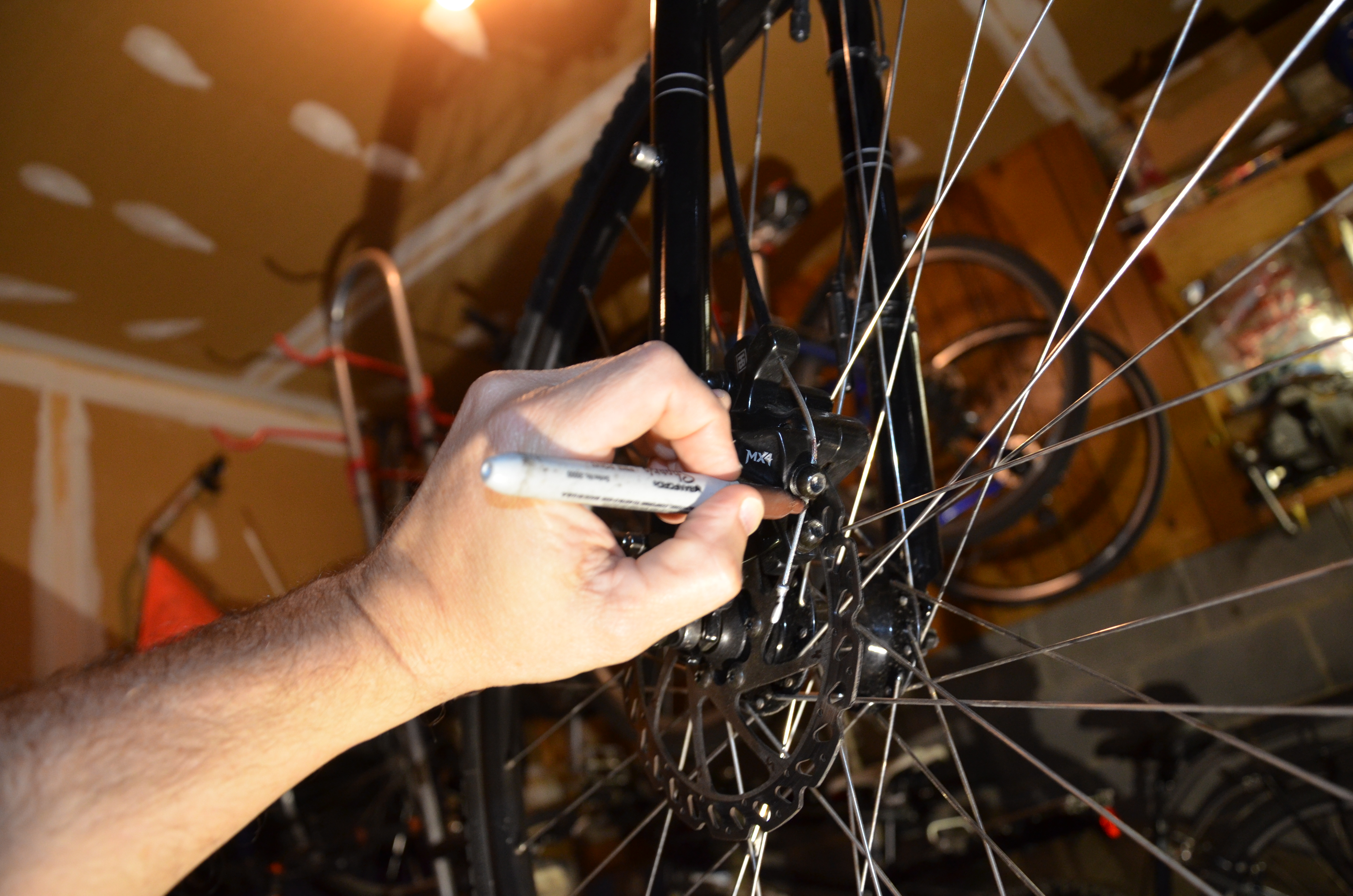
Brakes can be a bit trickier. With cable-actuated disc brakes, the only way to develop enough slack to lubricate the part of the cable that goes inside the housing is to release the cable bolts on the brakes. If this is something you do not feel comfortable with, the alternative is to lubricate the cable at the housing points only, which is better than no lubrication at all. If you do feel comfortable, before loosening any bolts, mark the cable with a Sharpie; this will show you where the cable has to be placed to return to adjustment. Once you loosen the cable, the caliper on disc brakes is going to go to the wide-open setting.
With rim brakes, you can release the slack by opening the brakes, much as you would when changing a tire. This should give you sufficient slack, but not always, depending on how tightly the brakes are set up. If you find that opening the brakes does not provide sufficient slack, you can follow the directions above for cable operated disc brakes by marking the cable with a Sharpie before loosening the brake cable. As with the disc brakes, loosening the cable will cause the brake arms to open fully.
While I’m certain this goes without saying, if your bike is equipped with hydraulic disc brakes, there are no cables to lubricate. Please do NOT attempt to loosen up the brake lines or remove them from the caliper. You will end up with a huge mess and a bicycle that is out of service.
Lubricating
The key to lubricating the cable is to use just enough to make the surfaces slick. If you over-lubricate, it will attract dirt and other kinds of gunk, which will cause the cable performance to deteriorate. My preferred lubricant for cables is ProGold’s ProLink Gold. I usually don a pair of rubber gloves, put a drop or two of oil on the cable, and run my thumb and forefinger along the various cable sections to lubricate them. On the brake cables, make sure you do not lubricate the section you marked with the Sharpie. The oil will remove the markings and you will have to adjust the brakes from scratch.
While you are running your thumb and forefinger over the cable, keep an eye out for any fraying. If the cable is frayed, it is time for a new cable. Riding with a fraying cable is like riding atop a time bomb. It is a question not IF the cable is going to fail, but WHEN. And, as I’ve learned, cables tend to snap at the most inopportune times. Riding a road bike over hilly terrain with only the 11-tooth sprocket available because the shifter cable snapped is not something I’d recommend!
If you can only lubricate at the housing points, I’d recommend getting a needle oiler. This will apply a very small drop of oil at the point where the cable emerges from the housing. Using a typical chain lube bottle may result in putting too much oil at the housing points. The needle oiler is great for lubricating derailleur pivot points as well.
Once you have lubed the cables, put the cable housings back in place. Shift the derailleurs back to their original settings on the large chainring, if possible, to take up the slack. With brakes, pull the brake caliper or brake arm so that the Sharpie marking is in its original position, and then tighten the cable bolt.
As usual, always do a quick check of your work, first on the repair stand by running through the gears and checking the brakes, followed by a test ride to make sure everything is working the way it should. If you did it correctly, you should notice smoother shifting, particularly when going from the small chainrings to the larger ones, and smoother brake engagement and modulation.
In the next Gears & Gadgets, we will explore what happens if you do need to replace a cable or cable housing. It’s not as difficult as it sounds.
Gears & Gadgets is a blog written by David Cohen #1116. It features various repair tips and tricks that David has picked up in nearly 25 years of cycling, including 12 years of public safety cycling. Gears & Gadgets will also periodically review some of the latest “gadget” items of potential interest to public safety cyclists. The advice and opinions in this column are solely the author’s and should not be interpreted as IPMBA mandates or recommendations unless explicitly stated.
About the author: David Cohen is a 12-year volunteer with the Maryland-National Capital Park Police. When he isn’t riding or tinkering with bicycles, David can be found tinkering with vintage cars or World War II airplanes. An avid historian, David enjoys researching and writing as well. He can be reached at onyxsax@aol.com. Photos courtesy David Cohen.