
Gears & Gadgets: Introduction to Fleet Management
by David Cohen
Maryland National Capital Park Police Reserve Unit
If you’ve recently become your department’s Bicycle Coordinator, hopefully, you were lucky enough to have a predecessor who was organized and left copious notes on the state of the bicycle fleet. However, it is more likely that the responsibility has been passed along to a number of people who are not truly committed to the job. That’s where a disconnect happens. Notes are lost and information tends to disappear. As the newly appointed fleet manager, you have “inherited” an entire shed full of bicycles and no idea what is the status of each bike. It’s up to YOU to bring order out of chaos.
Clearly, the first order of business is to obtain information on the bicycles and organize that information in a cohesive manner. The best tool for this is a spreadsheet. It doesn’t matter if it is done on Excel or Google Sheets or another spreadsheet program. It is easy to enter the data into the columns so you can view all the bicycles at a glance.
Name/Rank/Serial Number
If your department hasn’t done so already, the first order of business is to establish a way to quickly identify each bicycle. Our department uses the County-issued bicycle license number as the bicycle’s stock number. If you don’t have a bicycle license, numeric stencils affixed to the top tube or down tube will suffice. If you belong to a department that only has a few bicycles, color-coded tape works as well, with each bike assigned a single color, or a combination of two colors.
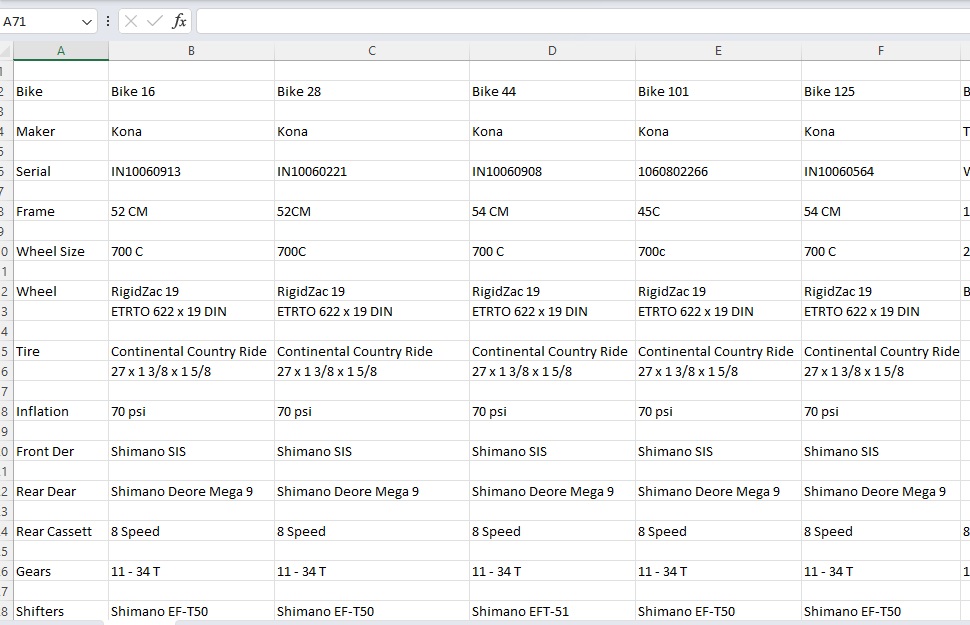
Once the bikes can be easily distinguished from each other, it’s time to get into the details. Basics for now are just fine: manufacturer, model, frame size, serial number. Getting to the serial number can be a bit inconvenient as many bikes have the number stamped on the underside of the bottom bracket, but recording it is certainly vital.
With this information, you have a basic rundown of the bicycle inventory, and by knowing the frame sizes, you can assign bicycles to personnel based on their height. You would not want to give a 5’ 8” (1.75 m) tall rider a bike with a 21-inch (53 cm) frame, or a 6’ 3’ (1.9 m) tall rider a bike with a 15-inch (38 cm) frame.
Another column can be added for the bike’s mechanical status. Is it ready for service? Does it need minor maintenance? Or possibly major maintenance? Is it sidelined with some kind of mechanical problem, like a faulty derailleur? You will determine the status when you do the bicycle survey (more on that subject in the next G&G column).
Details, Details, Details
Now that you have recorded the basics, it is time to get into the details. If you have bikes from different manufacturers, or even from the same manufacturer but different years, the componentry may vary. Having the specific componentry details at your fingertips can speed up ordering replacement parts. Or, if you have to cannibalize a bicycle to keep other bicycles in service, you can quickly determine which bicycles have interchangeable components.
Pretty much anything besides the frame could be swapped or replaced, so I track the following:
- Wheel size and manufacturer
- Tire size and manufacturer
- Front/rear derailleurs
- Shifter type
- Rear cassette, including number of gears and gear range
- Crankset and chainring counts (number of teeth)
- Crankarm length
Fleet Assessment
Once you have accumulated the data, it is time to assess the condition of the bikes. This is basically the ABC Quick Check, but with a particular focus on some common trouble spots.
Chain: A chain checker is a quick way to determine the condition of the chain. The Park Tool CC-3.2 is an inexpensive and effective chain checker. There are fancier ones out there if you’re a gadget person. If the chain is stretched, is only a matter of time before it fails. The bike should be taken out of service until the chain and rear cassette can be replaced.
Shifters/Derailleurs: One common problem I’ve come across, particularly on older bikes in the fleet, is that their shifter pods are inoperative. Sometimes they are just gummed up, but sometimes they have had an internal structural failure. The bike should be able to access all gears. If it doesn’t, it may just need some cleaning and tuning. Or it could need to have some components replaced. Set the bike aside for a more detailed look.
Wheels/Tires: Keep an eye out for out-of-true wheels, or ones with dented rims. Also check the condition of the tires. How much tread is left? Is the tire casing warped? Do the tires hold air? A wheel that is wobbly could just need to be trued, or it could be bent. Bent wheels need to be discarded. You might be able to pilfer a straight wheel off an out-of-service bike to get a bike that is in otherwise good shape back in service.
Brakes: Brakes should work smoothly and stop the bike quickly. In my experience, I’ve seen rim brake shoes run down to the wear indicators. Somewhat harder to discern is wear and tear on disc brake pads. Disc brake pads are also subject to contamination. If a disc brake-equipped bike does not stop crisply, chances are the pads are worn or contaminated. A test ride is usually a more effective gauge of stopping power than on the repair stand.
Cables: Both brake and derailleur cables should move smoothly. Any bike with frayed cables should be taken out of service, as those cables are likely to fail.
Headset: Over time, headsets can loosen up. A quick check is to put the bike on the ground, lock the front brake, and rock the bike back and forth. If you see any movement in the headset, the bike should have its headset tightened down. Sometimes, spongy shocks may feel like a headset issue, but with this test, a shock will give up-and-down motion, whereas a loose headset will yield a fore-and-aft motion.
Once you have completed the assessment, the bikes will fall into one of four categories:
- In Service: Bikes that are ready for patrol.
- Minor Maintenance: Bikes that may need adjustments or routine maintenance.
- Major Maintenance: Bikes that may need components replaced in order to return to service.
- Unserviceable: Bikes that may be beyond saving, or for which repairs would not make economic sense.
The delineation between bikes requiring major maintenance and bikes that are unserviceable will likely depend on your department’s budget for repairs. Short of a cracked or damaged frame, just about any bike can be repaired, but the feasibility of such repairs depends on how much money one is willing to throw at the bike, and what the end result may be. I’ve seen too many bicycles that have had multiple components replaced that ended up not being the sum of all their parts. At some point, it is less expensive to purchase a new bike than it is to keep fixing an old one.
Once the bikes are categorized, you’ll have a firm grip on the status of the bike fleet. In the next Gears & Gadgets, I’ll discuss maintenance plans/maintenance intervals for the bike fleet.
Gears & Gadgets is a blog written by David Cohen #1116. It features various repair tips and tricks that David has picked up in more than 25 years of cycling, including 15 years of public safety cycling. Gears & Gadgets will also periodically review some of the latest “gadget” items of potential interest to public safety cyclists. The advice and opinions in this column are solely the author’s and should not be interpreted as IPMBA mandates or recommendations unless explicitly stated.
About the author: David Cohen is a 15-year volunteer with the Maryland-National Capital Park Police. When he isn’t riding or tinkering with bicycles, David can be found tinkering with vintage cars or his collection of 19th and early 20th century musical instruments. An avid historian, David enjoys researching and writing as well. He can be reached at onyxsax@aol.com.
(c) 2023 IPMBA.