Gears and Gadgets: My Medic Cycle Medic Pro Kit
By David Cohen
Maryland National Capital Park Police Reserve Unit
EMS bicycles are always a sight to behold. It’s almost staggering the amount of life-saving gear that can be carried on these bicycles; even more so on their e-Bike counterparts. However, not all of us are EMS cyclists and carrying that amount of equipment on our bikes during our daily duties is not practical – even if we were trained on how and when to use it. The objective for the rest of us is to find a kit that provides sufficient first aid capability without adding significant weight to our service bikes.
Enter the MyMedic.com Cycle Medic Pro kit. MyMedic is a company that assembles kits of all sizes, from small first-aid kits to full-blown trauma kits. The offer two kits for cyclists: the Cycle Medic for $49.95 and the Cycle Medic Pro for $99.95. I purchased the Pro.
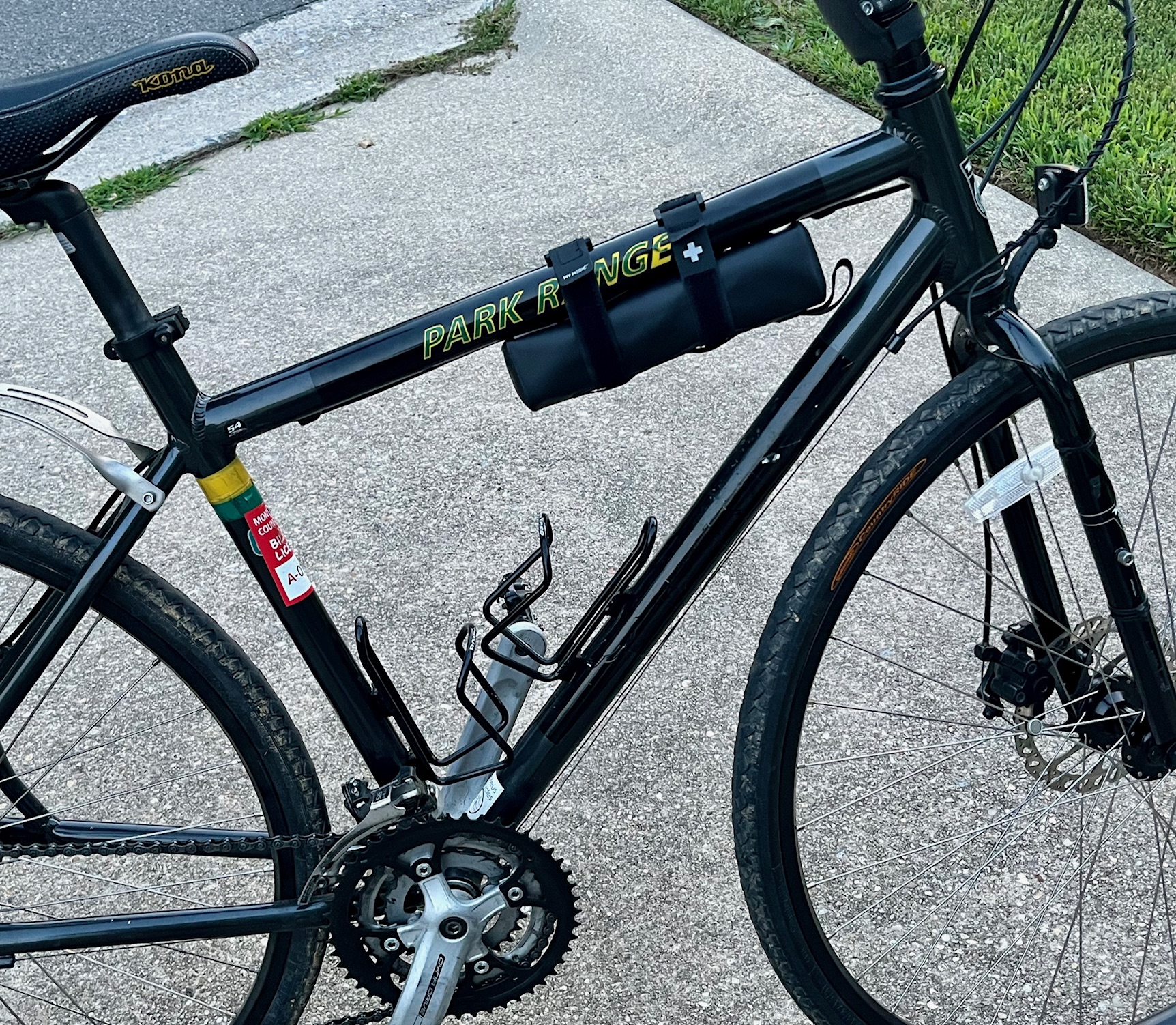
The kit is contained in a rectangular carry case that is 8.5 inches (21.6 cm) long, 2.5 inches (6.4 cm) wide and 2.25 inches (5.7 cm) deep. It can be strapped to the top tube or possibly the seat tube of your bike. The kit will fit in most standard trunk packs. It weighs in at 10.3 ounces (292 grams), but this lightweight kit carries a pretty good supply of equipment to meet basic first aid needs.
The items marked with the asterisk (*) are the items that come with the Cycle Medic Standard Kit:
- 1 RATS Tourniquet
- 2 Chest Seals
- 3 Superskin Blister Strips*
- 1 2” Roll Stretch Gauze*
- 2 Antiseptic Wipes*
- 1 Lip Balm*
- 1 Sunscreen*
- 1 Friction Frosting (Chamois Butter)*
- 1 Antimicrobial Hand Wipe*
- 1 Tubular Gauze – Large*
- 1 Pair Disposable Gloves*
- Wound Closure Strips (Band-Aids)*
- 2 2” x 4” Bandage*
- 2 Ibuprofen*
- 1 Kokos Drink Mix*
- 1 Sting Relief*
- 1 1” x 3” Bandage
- 1 Tubular Gauze – Medium*
- 2 Triple Antibiotic Ointment*
The difference between the Standard and Pro kits is the inclusion of the tourniquet, chest seals, and an additional bandage. Having these additional and potentially lifesaving tools on hand is well worth the additional $50 outlay. It is always better to have these items and not need them than need them and not have them.
While it contains some very useful items, it is clear this kit is aimed more towards the recreational cyclist than the first responder. However, MyMedic is willing to customize the kit upon request. For instance, if you wanted to swap out the lip balm and sunscreen for additional stop bleed items, they would be willing to do so. MyMedic also offers discounts for first responders, but they do not yet participate in the IPMBA Product Purchase Program.
The kit is secured to the bicycle by a pair of VelcroTM straps. There are three mounting points for the straps, which give you several options for carrying positions. I found the straps were too short to wrap around the kit and some of the larger diameter top tubes. On smaller frame bikes, carrying it under the top tube may impede access to the water bottle. It is possible to fasten it above the top tube if your bike does not have the banjo-style cable routing on the top tube that many older public safety bikes have. Given the recent trend for bicycles, particularly gravel bikes, to have all kinds of permanent mounts, I hope that MyMedic will eventually offer this as an option.
The kit is too long to attach to a down tube for bikes with frames 54 cm or smaller for road frames and will not fit 17” (43 cm) or smaller mountain frames. I found it more practical to carry the kit inside my trunk (rack bag), where its narrow profile takes up less room than the more conventional first aid kit that I normally carry.
Deployment is a matter of unstrapping the VelcroTM straps from the bike and pulling open the zipper. The trade-off for the compactness and lightness of the kit is that all the items are squeezed into the container, and you have to go through the kit to pull the item(s) you need. In practice, I found tossing the kit into the trunk was the easiest way to deploy it so you don’t have to waste time undoing the straps to free the kit from the bike. When it is carried in the trunk, it is just a matter of pulling it out and taking it over to the person who needs assistance.
The biggest advantage of the Cycle Medic Pro kit is its portability. When it’s not employed on the bike, I carry it in my car. It easily fits into the door panel pockets or the center console of all my vehicles. It is a considerable upgrade over the basic travel first-aid kits.\
Without a doubt, the MyMedic Cycle Medic Pro Kit is a solid first-aid kit for recreational cyclists. With some modifications, it would make an ideal small kit for public safety cyclists. Fortunately, MyMedic is willing to work with public safety professionals to customize the contents of the kit to maximize its effectiveness. It could use some improvements to how it attaches to the bicycle, but its overall portability makes up for this minor shortcoming.
The Cycle Medic Pro kit can be ordered from MyMedic at http://www.mymedic.com. ;
Gears & Gadgets is a blog written by David Cohen #1116. It features various repair tips and tricks that David has picked up in more than 25 years of cycling, including 15+ years of public safety cycling. Gears & Gadgets will also periodically review some of the latest “gadget” items of potential interest to public safety cyclists. The advice and opinions in this column are solely the author’s and should not be interpreted as IPMBA mandates or recommendations unless explicitly stated.
About the author: David Cohen is a 16-year volunteer with the Maryland-National Capital Park Police. When he isn’t riding or tinkering with bicycles, David can be found tinkering with vintage cars or his collection of 19th and early 20th century musical instruments. An avid historian, David enjoys researching and writing as well. He can be reached at onyxsax@aol.com.
(c) 2024 IPMBA.